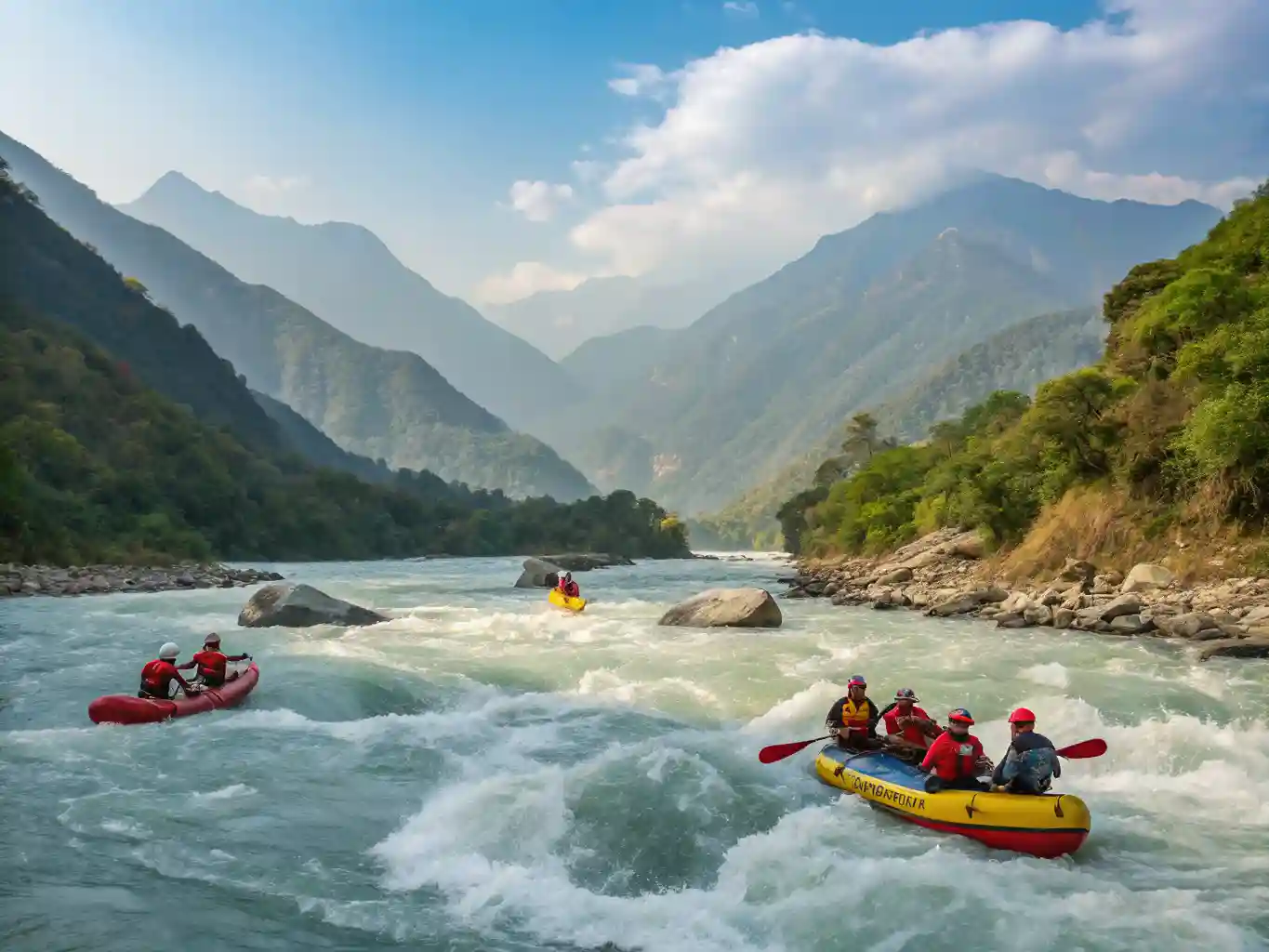
Nepal has long been sold to the world through one image: mountains. Snow lines, trekking trails, prayer flags, and high passes still define the country in the global imagination. Yet another Nepal has been rising with remarkable force, one shaped not by summits but by rivers. Fed by Himalayan snow, glacier melt, seasonal rain, and dramatic elevation drops, Nepal’s river systems create whitewater that is unusually varied, visually spectacular, and accessible across different skill levels. The result is a sporting landscape where rafting, kayaking, and river racing are no longer niche side activities for a small band of adventurers. They are becoming part of the country’s modern identity. Nepal Tourism Board promotes rafting and kayaking as major adventure activities, noting that trips can range from short outings to expeditions of up to two weeks, with the main seasons running from roughly October to mid-December and from March to early May.
This shift matters because brands are not built only on scenery. They are built on repeatable experiences, memorable stories, local expertise, and a clear difference from competing destinations. Nepal has all of that on the water. A visitor can drive a few hours from Kathmandu and find steep, technical rapids on Bhote Koshi, float a classic introductory run on Trishuli, or join a long expedition on Sun Koshi or Karnali that feels less like a day trip and more like a moving wilderness journey. The variety is wide enough to attract beginners, experienced paddlers, race participants, photographers, content creators, and travelers who want more than a postcard holiday. That breadth is exactly why river sports are turning into something bigger than recreation. They are turning into a recognizable national signature.
Nepal’s Rivers Are Turning Geography Into Identity
Nepal’s strength in water sports begins with pure geography. Few countries combine such steep mountain gradients with such a dense network of river systems flowing from the Himalayas toward the plains. That vertical drop creates fast, energetic water and a wide spectrum of rapids, from friendly sections for first-timers to demanding class IV and V stretches that appeal to skilled paddlers. Nepal Tourism Board emphasizes that the country offers rafting, kayaking, and canoeing across rapids graded from one to six, which helps explain why the destination can host both entry-level trips and serious whitewater challenges.
But geography alone does not create a brand. Plenty of countries have rivers. Nepal’s advantage lies in the way its rivers intersect with everything travelers already seek there. A rafting trip is rarely just rafting. It runs past terraced hills, suspension bridges, riverside villages, forests, and dramatic valley walls. Multi-day journeys add camps on sandy beaches and the feeling of moving through the country at water level rather than from a bus window or a trekking lodge. That mixture of sport and landscape gives Nepal something powerful: river experiences that feel cinematic without losing their raw edge.
Another reason these sports fit Nepal so well is that they expand the adventure economy beyond the standard mountain script. Trekking and climbing remain central, but river tourism brings a different pace, a different seasonality, and a different audience. Some travelers want intensity without altitude. Others have limited time and cannot commit to a long trek. Others simply want an adventure that is social, dynamic, and easier to combine with a broader itinerary. Whitewater answers all of those needs. A country that used to be framed mainly through foot travel is learning how to market motion in other forms: paddle strokes, river lines, sprint finishes, ferry glides, surf waves, eddy turns, and race days.
That matters for tourism branding because modern travelers often respond best to destinations that feel layered. Nepal is strongest when it stops presenting itself as only the home of Everest and starts presenting itself as a complete adventure nation. Rivers help complete that picture. They turn Nepal from a single-story destination into a multi-sport destination, and that makes the national image more resilient, more modern, and more commercially flexible.
Why Rafting, Kayaking, And Racing Are Growing So Fast
The rise of water sports in Nepal is not random. It is the result of several trends meeting at the right time. Adventure travelers now look for experiences that are active, visual, and emotionally sharp. Whitewater performs well on all three counts. It is instantly photogenic, easy to tell stories about, and exciting even for people watching from the bank. In the age of short-form video and social sharing, rivers have a natural advantage. A rapid is movement, noise, tension, release, and scenery all in one frame.
Accessibility is another major reason. Not every visitor can trek for ten days, but many can fit a one-day or two-day river trip into a Nepal itinerary. Trishuli has become especially important in that respect because it works as a practical gateway river between Kathmandu, Pokhara, and Chitwan. Bhote Koshi, meanwhile, appeals to travelers who want a shorter but much more intense experience close to the capital region. Commercial operators also promote longer expedition rivers such as Sun Koshi, Karnali, Tamor, Bheri, and Arun, creating a ladder of options from casual adventure to committed whitewater travel.
Events have also helped push the sport into a more visible public space. In early 2026, Nepal’s 50th International Rafting and Kayaking Festival and the 24th Himalayan Whitewater Challenge were held on the Trishuli River, underlining how deeply organized river sport is woven into the country’s outdoor culture. Reports on the festival highlighted both competition and broader calls for water tourism and river conservation, which is exactly the kind of message a national brand needs: not just thrill, but continuity, stewardship, and community.
There is also a local expertise story behind this growth. Nepal is not selling an imported adventure model. It has built guide culture, safety instruction, expedition know-how, and operator experience over decades. That gives the sector credibility. Travelers are far more likely to choose a destination when they feel the sport belongs there rather than being lightly packaged for outsiders. In Nepal, river culture feels earned. It has history, personalities, and established routes. That authenticity makes a huge difference in a market crowded with destinations promising adventure.
A final factor is emotional contrast. Nepal’s rivers offer something many premium travel markets now crave: real excitement without full detachment from place. On a river trip, the adrenaline is obvious, but so is the landscape and the human setting around it. The sport never feels sealed inside an artificial tourism bubble. It moves through real valleys and communities. That keeps the experience grounded, and grounded experiences are often the ones people remember longest.
The Routes That Define Nepal’s Water Sports Image
If Nepal’s new river identity is to make sense to travelers, it needs recognizable routes. A strong destination brand is easier to understand when it can be told through specific names. In Nepal, those names are already there. Some rivers work as introductions, others as tests, and others as full-scale expeditions. Together, they create a map of the country’s whitewater personality.
The most useful way to understand this landscape is to look at the core rivers that repeatedly shape paddling itineraries and public perception.
| River | Best For | Typical Character | General Trip Style | Location/Access |
|---|---|---|---|---|
| Trishuli | Beginners to intermediate rafters, festival racing, short breaks | Friendly but lively whitewater with enough action to feel adventurous | 1–2 day trips, easy add-on between major tourist hubs | On the main travel corridor linking Kathmandu, Pokhara, and Chitwan. |
| Bhote Koshi | Adrenaline seekers, experienced paddlers, strong kayakers | Steep, fast, technical, and intense | Short but high-energy trips, often weekend style | Around 3–4 hours from Kathmandu, making it one of the quickest serious whitewater escapes. |
| Sun Koshi | Expedition rafters and intermediate to advanced kayakers | Big-volume whitewater, remote feel, long river days | 8–10 day multi-day classic | One of Nepal’s best-known expedition rivers with strong international appeal. |
| Karnali | Wilderness lovers, multi-day rafters, serious paddlers | Remote, scenic, powerful, less crowded | About 9–10 days | Western Nepal, offering a more isolated expedition feel. |
| Seti | Softer entry-level adventure, mixed groups, scenic floaters | Warmer, gentler, more relaxed than the hardest rivers | Short to mid-length trips | Often chosen by travelers who want scenery and water time without extreme technical difficulty. |
| Tamor / Arun / Bheri | Advanced travelers seeking longer river journeys | Expedition-style rivers with strong scenic and sporting value | 6–10 day trips | Less mainstream, more specialized, ideal for paddlers looking beyond the famous names. |
This route picture explains why Nepal’s water-sports story is so strong. It is not dependent on a single flagship product. The country has a layered offer. Trishuli draws newcomers and event traffic. Bhote Koshi supplies the short, intense burst that modern adventure tourism loves. Sun Koshi and Karnali carry the mythology of long river journeys. Seti broadens the audience. Tamor, Arun, and Bheri deepen the country’s reputation among committed paddlers. That spread gives Nepal something tourism boards everywhere want: a product ladder that allows visitors to enter at one level and come back for another.
For travelers planning by route rather than by sport label, the choices become clearer with a simple frame:
• Choose Trishuli if you want an easy first whitewater experience that fits a broader Nepal trip.
• Choose Bhote Koshi if you want speed, technical water, and a compact adrenaline weekend.
• Choose Sun Koshi if you want the classic long river expedition that feels like a journey across landscapes.
• Choose Karnali if remoteness and wilderness matter as much as the rapids.
• Choose Seti if your group wants beauty, fun, and lower stress.
• Choose Tamor, Arun, or Bheri if you already know that the less obvious river is often the richer story.
That range is exactly why river sports can function as a brand rather than a trend. Nepal is not asking visitors to believe in one famous run. It is inviting them into an entire river system with distinct personalities.
Water Racing Is Giving Nepal A Modern Competitive Edge
Rafting and kayaking sell adventure, but racing adds something even more valuable to a destination image: spectacle. Competitive whitewater creates headlines, recurring events, athlete narratives, and a sharper sense of legitimacy. It tells the world that a country is not just a place where tourists dabble in a sport. It is a place where the sport is lived, tested, and celebrated.
Nepal has been benefiting from exactly that effect. The 2026 international rafting and kayaking festival on Trishuli did more than fill a calendar. It publicly reinforced Nepal’s claim to be a whitewater nation. Competitive formats such as raft races and kayak cross translate well for audiences because they are easy to grasp. Boats charge downstream, teams fight lines and time, paddlers sprint through complex water, and the river itself becomes part of the drama. Reporting on the 2026 event highlighted participation, podium finishes, and public discussion around protecting rivers while expanding adventure tourism. That pairing is important. It presents river sport not as a one-off stunt but as a serious sector with future ambitions.
Race culture also helps local talent. It gives guides, athletes, instructors, and clubs more visibility. That matters for destination branding because human stories are often more persuasive than landscape slogans. A country becomes memorable when visitors feel there is a scene there, not just a service. Nepal’s race events point to a scene: paddlers training, teams forming, clubs competing, guides building careers, and communities gathering around river sport. It creates a sense of continuity that day-trip marketing alone cannot achieve.
There is a wider branding benefit as well. Competitive river sport is younger and fresher in the public imagination than classic trekking imagery. It allows Nepal to speak to a generation that values movement, challenge, and skill-based travel. A race is not passive sightseeing. It is dynamic and contemporary. That gives Nepal a way to update its adventure identity without abandoning the mountain heritage that made it famous in the first place.
At the same time, water racing helps reframe rivers as cultural assets rather than just tourism resources. Once competitions, festivals, and clubs become part of the conversation, rivers begin to hold public meaning. They become places to protect, invest in, and celebrate. That is the foundation of a durable brand. The strongest destination brands are built around places that people care about beyond their commercial use.
What Travelers Should Know Before Choosing A Nepal River Trip
The beauty of Nepal’s river scene is that it can meet very different expectations, but that only works when travelers choose with honesty. The wrong river can turn a dream trip into a stressful one. The right river can create the exact kind of memory that brings people back.
Season matters first. Nepal Tourism Board states that rafting trips are usually planned in the dry seasons from October through mid-December and from March through early May, while some operators extend favorable periods into June depending on conditions and route choice. Water levels influence both safety and feel. A river that is perfect for an intermediate paddler in one part of the season may feel very different at another time. Serious operators brief clients carefully, and travelers should pay attention to those briefings rather than booking by image alone.
Skill level matters just as much. Trishuli and Seti often suit newcomers or mixed groups more comfortably. Bhote Koshi is frequently described as a steeper and more technical ride, which is precisely why it attracts thrill-seekers and confident paddlers. Sun Koshi and Karnali demand more commitment, not just in technique but in attitude. These are journeys, not quick experiences to squeeze in without preparation.
The most practical way to choose is to think about the trip you actually want, not the one that sounds most impressive. Ask yourself whether you are after a social day on the water, a short rush of hard whitewater, or a multi-day expedition with long river miles and camp life. Those are very different forms of travel. Nepal offers all of them, which is a gift, but that variety only works when the decision is clear.
It also helps to think beyond the rapids. Some trips are best for travelers who want to combine river time with Kathmandu, Pokhara, or Chitwan. Some are better for people who want the river to be the central event. Some suit groups, while others are more rewarding for travelers who already have paddling experience and want a stronger technical challenge. The river is only part of the answer. The rest is pace, logistics, comfort level, and the kind of story you want your Nepal trip to tell.
The Future Of Nepal’s Brand Will Flow Through Its Rivers
Nepal does not need to replace its mountain identity. It needs to widen it. That is why water sports are so important. They do not compete with trekking, climbing, or heritage travel. They strengthen the country’s full adventure profile and make it more relevant to a broader range of visitors. A traveler can come for a trek and leave talking about a river. Another can skip the long hike and still feel they have met Nepal in a powerful, physical way.
The strongest sign of change is that rafting, kayaking, and water racing are now telling a larger national story. They speak of energy, adaptability, youth, local expertise, and the smart use of natural geography. They also point toward a more balanced tourism future, one that spreads attention across regions, trip lengths, and traveler types. That kind of flexibility is valuable for any country trying to sharpen its place in a competitive travel market.
There is also a symbolic power in rivers that mountains alone cannot provide. Mountains are often admired from a distance. Rivers are entered. They demand participation. They make a traveler part of the landscape rather than just a witness to it. That feeling is one reason so many visitors leave Nepal with river memories that surprise them in their intensity. The water is not background. It is encounter.
If Nepal continues to invest in safety, event visibility, river protection, local training, and smart route storytelling, its future adventure brand will become richer and more distinctive. The world already knows Nepal as a place of height. More and more, it is becoming known as a place of flow as well. That is not a secondary identity. It is one of the country’s most exciting strengths, and it may become one of its most persuasive travel stories in the years ahead.