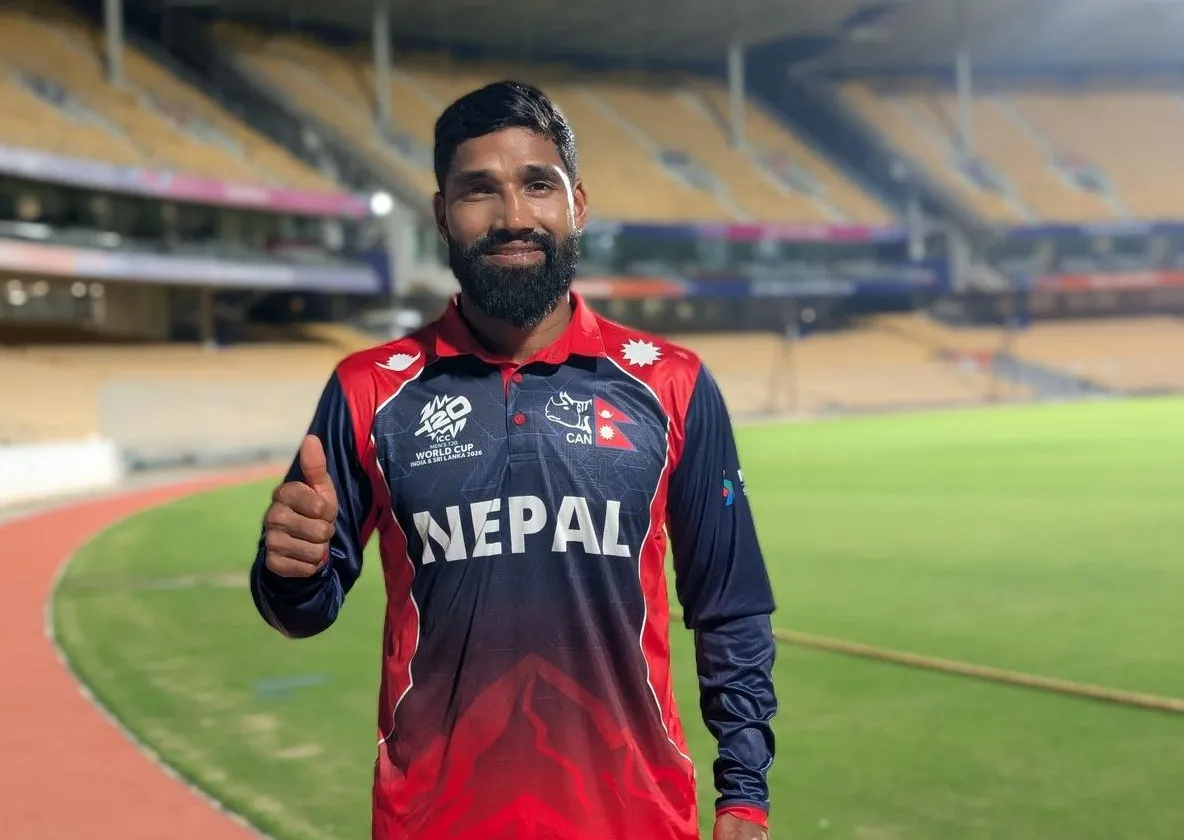
Nepal cricket has reached the point where every leadership decision carries more weight than before. The team is no longer treated as a nice underdog story alone. It is now judged by how it handles pressure, how it balances formats, and how quickly it turns promise into results. That is why Dipendra Singh Airee’s appointment as Nepal’s T20I captain matters so much. It is not just a change of name on the team sheet. It is a sign that Nepal wants a sharper T20 identity while keeping Rohit Paudel in charge of the ODI side for the ICC Cricket World Cup League 2 campaign against UAE and Oman.
The timing is important. Nepal played a two-match T20I series against the UAE in Kirtipur under Airee’s captaincy, then moved straight toward the League 2 tri-series starting on April 25. The official ICC preview confirmed that Nepal would host UAE and Oman in six League 2 matches, and that the event had been postponed from March before being rescheduled in late April. That makes the captaincy split look less like a symbolic move and more like a practical one. Nepal is trying to sharpen one leadership style for T20 cricket and another for the longer ODI grind.
Why Nepal made Airee the T20 captain
Airee is not an experimental choice. He is already one of the most recognizable cricketers in Nepal’s setup, and not only because of his finishing ability. ESPNcricinfo notes that he set the record for the fastest T20I fifty, reaching it in nine balls against Mongolia in 2023, and later became one of the few players to hit six sixes in an over in a T20 international. Those moments made him famous, but they also shaped how people see him: calm under pressure, naturally attacking, and comfortable in quick-turnaround situations.
That profile makes sense for a T20 captain. Nepal does not need a leader who simply survives the format. It needs someone who understands tempo. T20 captains are judged differently from ODI captains. They have less time to repair mistakes, fewer overs to hide a weak phase, and more pressure to get match-ups right. Airee’s game naturally belongs to that faster world. Nepal’s selectors appear to have recognized that, while still trusting Paudel to handle the broader ODI responsibilities.
There is also a practical reason behind the move. Paudel was not included in the T20I squad for the UAE series, while Airee remained vice-captain in the ODI group. That means Nepal did not simply hand over the T20 role as a publicity gesture. It created a real format split. In modern international cricket, that often signals a team trying to specialize rather than improvise.
What the UAE series revealed
The two UAE matches gave a quick but useful snapshot of where Nepal stands. In the first T20I, Nepal made 122 for 8 in a rain-affected innings and then lost by six wickets on the DLS method. UAE chased the revised target with authority, which exposed a familiar problem for Nepal: when the batting start is not strong enough, the margin for recovery becomes very small.
The response in the second game was much better. Nepal chased 129 and won by eight wickets with 25 balls remaining, leveling the series 1–1. That result mattered because it stopped the series from becoming a story about a poor start under a new captain. Instead, it turned into something more balanced: an example of a side adjusting quickly and showing that one bad night did not define the new setup.
That split result is probably more useful than a comfortable 2–0 win would have been. Nepal got a reminder that T20 cricket punishes slow starts, but it also showed the squad can recover, reset, and respond. For a team trying to build a clearer T20 identity, that is valuable information.
Why Airee fits this team better than a generic captain
Airee’s appeal is not only about highlight moments. Nepal’s T20 side often looks best when it blends urgency with control. It does not have the luxury of carrying passengers in the batting order, and it cannot afford confused middle-overs plans. A captain with a natural feel for acceleration, finishing, and changing momentum suits that reality better than a purely conservative option.
Before looking at the deeper issues, it helps to understand the specific qualities that make Airee a logical T20 leader for Nepal right now:
- He already carries big-match credibility in the shortest format.
- He plays with enough intent to match how modern T20 sides want to score.
- He understands pressure roles in the middle and late overs.
- He gives Nepal a captain who can lead through action, not only through field changes.
- He allows the team to keep ODI and T20 decision-making separate without creating a full split in the dressing room.
Those points matter because Nepal is no longer building from zero. This is a team that has already produced headline moments on the world stage and now needs more structure around them. Airee is a strong fit for that phase. He represents ambition, but he is also familiar enough with the squad to make the transition feel natural rather than forced.
Where Nepal still looks vulnerable
The encouraging part of Nepal’s current direction is easy to see. The more difficult part is what still holds the team back. The first UAE match showed how quickly a T20 side can become reactive if the batting innings does not begin with enough authority. A total of 122 for 8 in a shortened innings was never going to leave much room for error, even with quality bowlers in the attack.
There is also a broader issue around role clarity. Nepal has talented players, but the side still looks strongest when the top order gives the middle overs a clear platform. When that platform is missing, too much pressure lands on the middle order to both rebuild and finish. A team can survive that problem for a few games, but not for an entire cycle.
Another challenge is that the calendar is tight. Nepal had the UAE T20Is, then quickly turned toward the League 2 fixtures against UAE and Oman. In such a schedule, leadership is not just about inspiration. It is about clear communication, sensible rotation, and keeping players mentally fresh across formats.
What this leadership split changes for Nepal
Nepal’s current setup is easier to understand when seen as a format-based strategy rather than a hierarchy debate. Airee leading the T20 side and Paudel leading the ODI side suggests the team wants to prepare more specifically for what each format demands. T20 needs sharper rhythm, quicker field decisions, and bolder use of momentum. ODI cricket needs patience, longer planning, and more controlled phases with bat and ball.
The change becomes clearer when the current picture is laid out simply.
| Area | What Nepal is showing in April 2026 |
|---|---|
| T20 captaincy | Dipendra Singh Airee leads the format-specific squad |
| ODI captaincy | Rohit Paudel remains in charge for League 2 |
| Immediate T20 result | Nepal lost the first UAE match, then won the second to level 1–1 |
| Next major assignment | League 2 matches against UAE and Oman in Kirtipur |
| Main opportunity | Build a clearer T20 identity without disturbing ODI continuity |
| Main risk | Strong talent, but still vulnerable to slow starts and batting pressure |
This layout shows why the move feels sensible. Nepal is not tearing up its leadership structure. It is refining it. That is usually the smarter path for a team that wants progress without unnecessary instability.
What Nepal must get right next
The next stage is not about making the captaincy story bigger than the cricket itself. Nepal now needs to use this leadership split to improve the details that decide close matches. The UAE series already hinted at the areas that matter most: starts with the bat, role clarity through the middle overs, and the ability to stay composed when the first plan fails.
That is why the team’s immediate priorities look quite clear:
- Build more reliable powerplay batting so the middle order is not constantly repairing damage.
- Give Airee enough authority to shape the T20 style instead of only carrying the captain’s label.
- Protect ODI stability under Paudel as League 2 matches begin.
- Use the UAE and Oman fixtures to test combinations, not just chase short-term results.
- Keep the dressing room aligned so the captaincy split feels functional, not political.
These goals sound simple, but they matter because Nepal is now in the stage where small structural gains can produce meaningful results. Associate teams often get attention for one famous upset. The stronger ones learn how to turn those moments into a stable identity.
Why this story matters beyond one series
It would be easy to reduce Airee’s appointment to a short news cycle: new captain, two matches, one win, one loss, and then the conversation moves on. But that misses the larger point. Nepal cricket is trying to become more deliberate. A team does not separate captaincy roles unless it believes it is mature enough to think by format and by long-term needs. That is a sign of growth.
Airee also brings something useful from a public perspective. He is the kind of player who can connect performance and mood. Supporters know his record-breaking T20 background, and teammates know he has already handled pressure moments. That matters in a format where belief can change very quickly over the course of a single over.
Nepal’s new T20 direction under Dipendra Airee is not finished, and it is not proven yet. But it already looks purposeful. The UAE series showed both the weakness and the promise. The League 2 fixtures will test whether the broader structure around this team is strong enough. If Nepal can combine Airee’s urgency in T20 cricket with Paudel’s ODI continuity, it will not just have two captains. It will have a more modern cricket team.